

This week, I spoke at Swift Bharat with a talk titled “The AI-Enhanced App,” which focused on how we, as mobile developers, can integrate AI in our apps in useful ways that solve real user problems. A big part of the talk focused on training our own app-specific feature-specific models, so some of the attendees approached me after my talk and asked me for more details on how do that.
Here is the thing, it’s not that hard. You don’t need a Ph.D. in AI to do it. And it’s getting much much cheaper to do it.
There is also a popular misconception that AI models are too big to use on mobile. Just to point out how untrue this can be - I personally have one in-app model I trained in production that is only 5MB! That’s it! It’s extremely specific to only one tiny task, but it’s really really good at that one task, and it works! Many apps would benefit from shipping tiny app-specific models.
For bigger models, there are now companies and services coming up where you can host your own bigger model and call it via an API through your app. So that’s also an option.
But before I jump into the “how,” I will start with the “why” since this will serve as your motivation to look into it and make it happen! I will then continue with “the how” in follow-up blog posts, as there are many parts to this. Subscribe below if you don’t want to miss out:
There are No “Good” AI Labs
I personally love Claude, ChatGPT helped me get started back in the day on a very difficult project, and I use Gemini models for a lot of data processing. I was happy to have my cute bot team via GrokBot (until it got weird… more on that later…). I also experiment with new models and products regularly.
But no matter how much I use and love these products daily, I’m under no illusion that any of the labs behind them are “good.” Let me explain…
Back in the day, when people started companies, they did so with soul and integrity. Take Google and their “Don’t be Evil” slogan. They started out with good intentions, but of course as they got big and more corporate, they may have veered away from that toward creating “shareholder value”, which happens to most companies. However, the seed of the company came from a good honest place. This is important.
In contrast, there is not even an ounce of honesty or integrity in the seed of any AI Lab by definition. Each AI lab stole copyrighted protected data without a care in the world. They started as evil. Anthropic even went as far as acquiring precious ancient books just to scan them and burn them so nobody else can have them. OpenAI attacked HuggingFace “just because.” Look into it more, and you’ll only be more and more horrified by what you find.
Apple seems to be the only stand-out, but without training on user data or integrating the other labs that have, they have no future in AI-powered devices. No matter how Apple-apologist we can get, we all know that Siri is not anywhere near where it should be. This is the result of being “good,” and it won’t last.
Now let’s get back to the “why” part of the blog post. Ok, so we all accepted or were forced to accept the intellectual theft by these companies. So we have moved forward as a society using the AI they created for our own work. Or at least I think of it as the technology that belongs to all of us, since all of us helped contribute to it (involuntarily). And we’re paying for these labs to run it via the expensive compute. Fine.
But knowing that these companies are seeded with dishonesty and lack of any sort of social code or integrity, we cannot ever fully trust them. And they have done nothing but break our trust over and over again. This lack of trust is the main reason to strive to own your own models and data, but I’ll break this out even further into the serious business risks that using these labs for your business creates across several trust vectors:
Pricing Fluctuation
We’ve all experienced this. We start by using the $20 tier, then it becomes unusable, then we upgrade. Now OpenAI has introduced the $500 tier, so your $200 tier has dropped to half the value.
GrokBot was giving away essentially free usage. People put their whole business on it, only for it to be undercut suddenly out of nowhere without a warning.
App business specifically can be really tight. We need to know how much spend we need to do per user. Even if we’re willing to spend the API costs from these labs, we have no guarantee that they will not increase their pricing all of a sudden without any warning.
This sudden fluctuation is especially hard to deal with for us as Apple Developers, because of the App Store Review bottleneck. Sure, we can swap out a new model on the server, but that might come with some necessary UI changes or price changes for the user. So relying on the Big Lab models is a HUGE business risk.
Usage
Even if the pricing stays the same, the Big Labs are constantly introducing random usage limits. 5-hour limits. If too many people are online at the same time, they serve worse models for everyone to save costs. We have no control over any of this.
This is especially true for Apple’s Private Cloud Compute model - it has rate limits per user per device that we cannot even get a warning about in the API. So you never know when a user’s limit is about to run out and actually runs out and the app stops working for them, so you always need to have a cloud backup for Apple’s PCC model.
By having our own models that we control, we don’t need to be blindsided by these arbitrary usage limits.
Guardrails
The Big Labs, especially Anthropic, are HUGE on adding random and changing guardrails to their models. One day the same prompt is working, the other day it violates their policy. And they set blanket guardrails (e.g. game development) that may not even make sense for your use-case (you’re not doing anything malicious, but they don’t care…). Take for example, the recent “security” guardrails that would happily trigger for any basic dev request with no way out for normal coding but to downgrade to a lower Opus model.
But the most problematic guardrails right now, as again in Apple’s Private Cloud Compute model. I think they have a list of words to trigger them (for example, the word “trigger” in this sentence will set off the guardrails because it can be associate with gun violence).
When you have your own model, again, you don’t need to be blindsided by the Big Labs moral guard-railing that arbitrarily blocks something super normal in your app.
Deprecation
I don’t believe that models should be deprecated in the same way as bugs in a software. If a particular model works super well for your task, why not continue to use that model. A new and “better” model doesn’t guarantee that it’ll work well for your specific task.
I’ll give a very obvious examples. As new models have become better at coding, they’ve become clearly worse (very very very very bad) at writing. If I need a model to use for writing in my app, I don’t want the latest model. In fact, I personally use a very very old and outdated open source model as a writing model that Opus controls. It’s very slow, but it writes well.
Yet, for some reasons, Big Labs are super trigger happy on deprecations. Sometimes deprecating models as soon as 1 month after release… Here is the best-case scenario of deprecation that comes from Google…
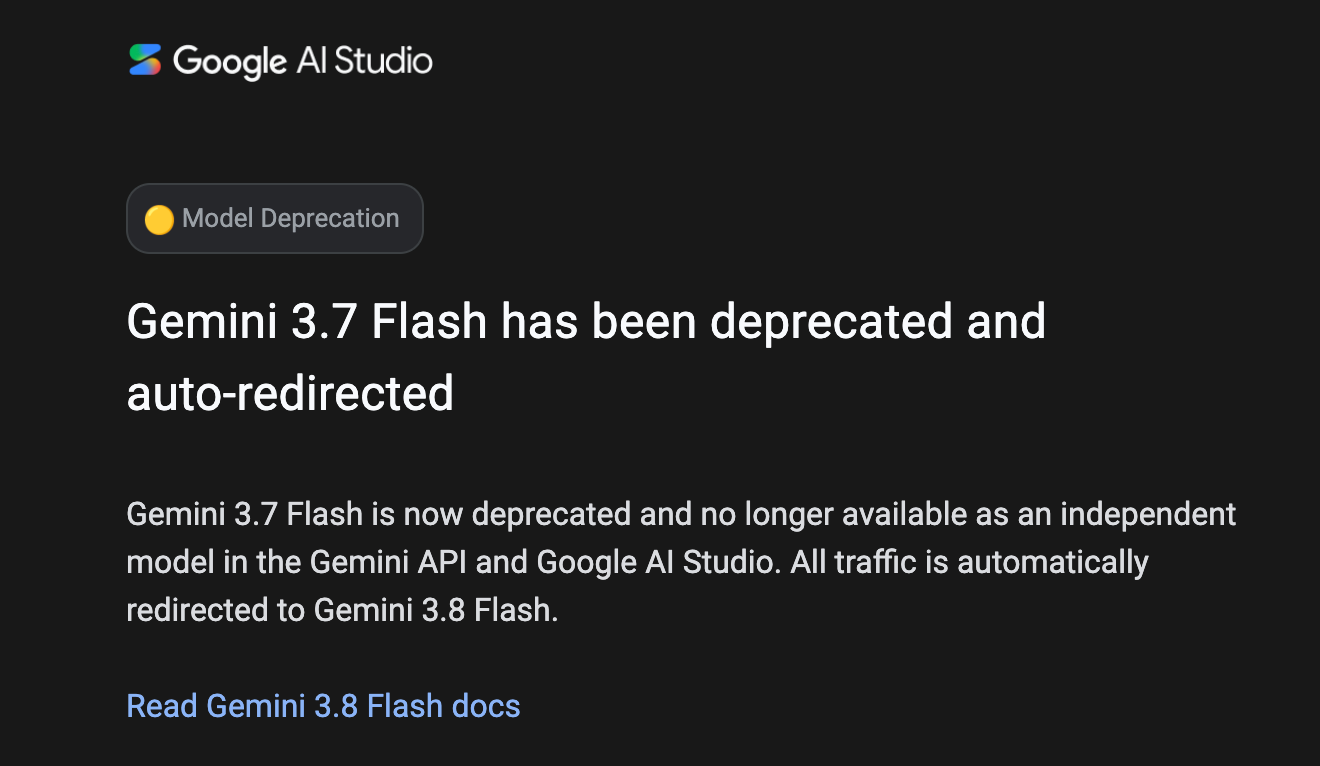
At least they warned me about it and redirected the endpoint… but they did it so suddenly, I have no idea and no time to test whether the new model can do my task.
This is a serious business risk for mobile apps just as much as the pricing and usage and guardrails. Suddenly, your app’s AI feature is acting weird and again, any app change you need to make to adjust takes time for Apple to approve.
Privacy
Finally, we all know that any data we give to the Big Labs will be used for training their models further, and even going as far as stealing our business entirely… This has already happened to the mathematics community. A researcher who used ChatGPT to work through his proof had his own work used by OpenAI to brute force the solution (if only they gave him $10 million to try and solve it instead!).
So again, this is a big business risk that you pass on to all your customers when using AI Lab APIs. You’re taking their usage and data and handing it over to the labs. I personally would never use Anthropic’s Zoom alternative no matter how good it is because I know they’ll be “listening” to my private meetings and training on that private data. In the same way, I don’t trust any product these Big Labs release.
The only way to keep your mote and your user’s mote is to train your own models that you have full control over!
Conclusion
The Big Labs have done absolutely nothing to earn our trust. I continue using them because they do release great products and features, but I’m always building tools and workflows that are meant to cut them out of the loop in the long term.
I’m not in a place to spend the money necessary to get my own supercomputers to train on and run big models, but that’s my long-term goal. I’m already building a GrokBot competitor that I control. I’ll be sharing it soon!
So this is the “why”. As you can see, it’s a BIGGGGGG WHY!!! No matter what you’re building, if you want to add AI to it, start learning how to do it. And yes, it is easy, and it is possible for you! I’ll be writing about the how next. So subscribe to follow along!